
|
|
14-Jun / 0 COMMENTS
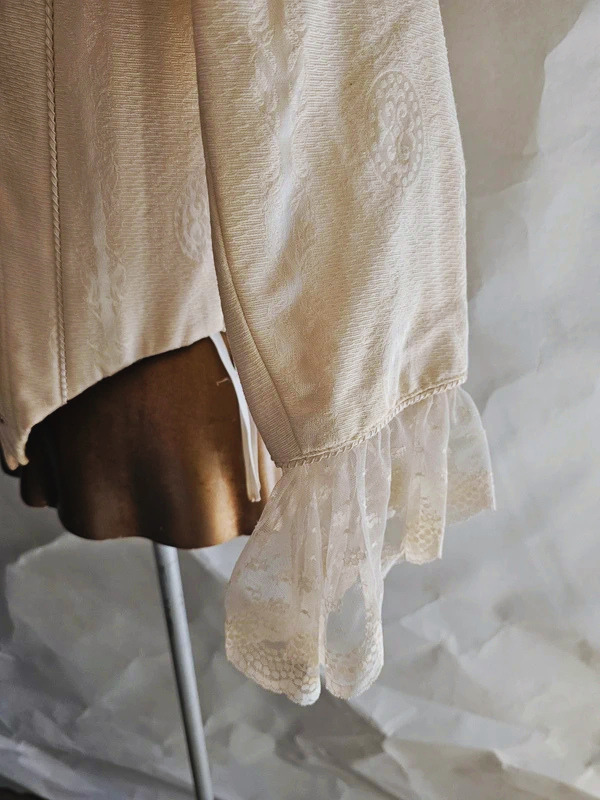
In the last post/ visit to my historical costume capsule I shared my first decisions and steps into making my first historically based garment- a 1770’s English style dress, which was meant to be used during my performances. Today I will be telling and hopefully showing a bit about my latest addition to my tiny collection. This new addition was very much needed, since I have outgrown my English style dress and a bodice, that I made from a lighter weight fabric around the same time 10 years ago. This is a good moment to mention that when I sewed those garments I only had a few modern sewing techniques under my belt – sewing a straight stitch and using a zigzag stitch on a sewing machine. Which meant I wasn’t aware of sewing techniques that allowed for easing a seam later on, let alone planning for body changes. Some years later while reading the book “The American duchess guide to 18th century dress making” by Lauren Stowell and Abby Cox, I have found out about 18th century sewing techniques which allowed extra fabric very niftily into folds that can be opened and reshaped at a later date, and enable a garment to be worn longer. Maybe it would be interesting to go back and talk about these techniques at a later date. Maybe even go back to the garments I made 10 years ago and talk further about what I’ve done “wrong”, what techniques would have made these garments stay longer in use. I’m really interested in trouble shooting how to fix my “wrong” past steps, so that I can bring these items back to the rehearsal and stage spaces. I’m using quotation marks when I write these were wrong steps, because even though they were not based in historical practice, I still created clothes for myself which I have used for a long time. Clothes I sang in, ran in, climbed in and jumped in. They served me well, while they fitted my body- and had a role in telling the story during my performances. They did it of course visually, for the audience, as well as gave very real borders for my movements on stage to play against. Very important to mention, especially for those among us that spend their time mostly in the heads, I could not have learned to make these clothes without trying to first sew them for myself. Yes, books are out there, and they are chuck full of information – but obviously sewing is a hands on activity. You can read all you want about techniques, but só much of the information of how to create exists between the body of the maker, and the materials and tools they work with. Any maker will tell you that much of the learning cannot happen without the steps which consist of actual doing.
So with all the love I have for my first English dress and bodice, it was high time for a new bodice that would suit my body as it is right now. This desire was back in my mind for a while. In the meantime I have made a late 18th century vest, as well as adjusted a Greek style dress that already existed my costume capsule. Hopefully I will be able to talk about those in greater detail in the future. While browsing online on a second hand site I came across what seemed to be a beautiful creme colored, fully boned and ready to wear bodice. The listing only mentioned it has come from a German theater, which translated in my understanding into- an item that would be probably well made by the garderobe employees of the same theater. This assumption is based on what I have seen while working in the state theaters in Germany as a singer. The costumes are usually either made by the workers of the costume department within the same theater for a specific production, or bought second hand and adjusted by the costume department to fit a specific productions. Together with the clear listing, photos and a theater origin gave me a lot of hope that the garment will suit my purpose of using it on stage again. I have written to the seller to ask if they knew from which theater it was from and which production it was made for, but unfortunately the seller did not have more information than what they already put in the listing.
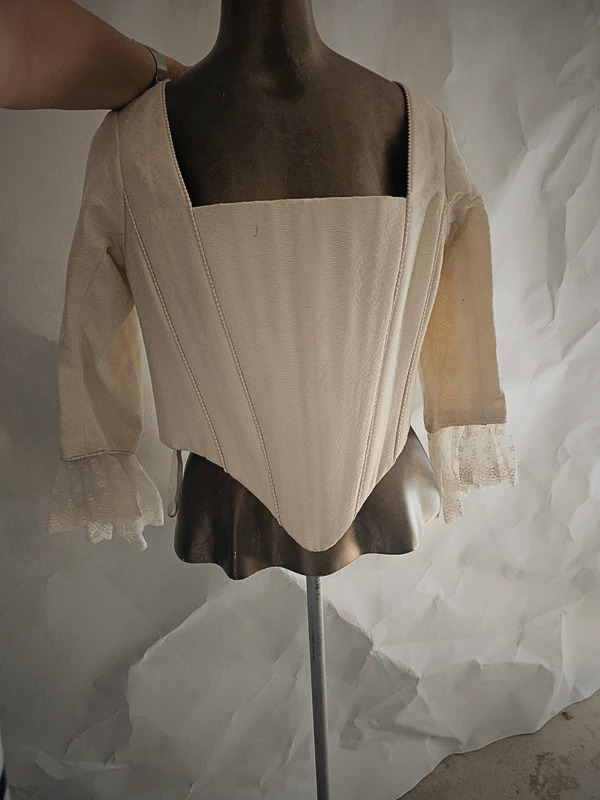
Two Things spotted from the listing’s photos that jumped out to me as interesting:
The closure of the bodice is at the back. The bodice has the general shape of a mid to late 18th century bodice of an English gown, but the closure is not typical to that time period (frontal opening), but rather a back lacing closure. This would make sense in the context of a German theater, because at the dressing rooms there would be a theater costume department employee to make sure all the items of clothing belonging to each character are in their place, to iron the wrinkles out each item, to repair an item if rips or tares are found, to help find a replacement if an item is lost, and of course lay all the parts of a character’s costume out in time for each actor/singer to wear while preparing to go on stage. They also help dressing the actors if a garment is difficult to put on alone. Like in our case, when a closure needs to be laced at the back.
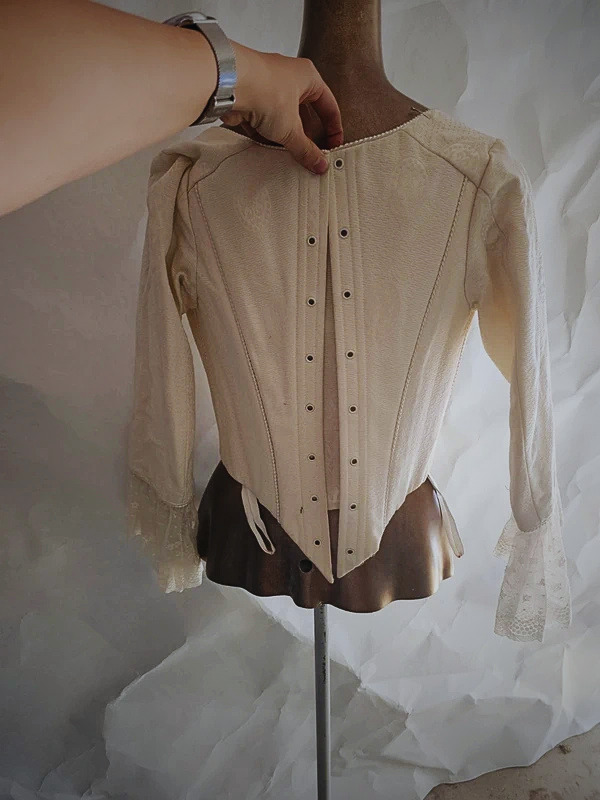
The bodice is fully (or to be accurate, generously) boned, as I mentioned earlier. This is usually done in theater for ease and speed of dressing. 18Th century female garments consisted (in very general terms) of a set of undergarments, such as a shift, stays, an under petticoat, a pocket or set of pockets (which were tied at the waist) , as well “over garments” which usually meant an over petticoat, a bodice or a dress opened at the front to show the petticoat, and a kerchief. Having a bodice generously boned (with plastic boning, (just to make sure no one across the screen is clutching their pearls or jumping at the barricades) means there is no great need to wear stays underneath to create the desired 18th century barrel shape. This also means getting ready faster for the actor/singer.
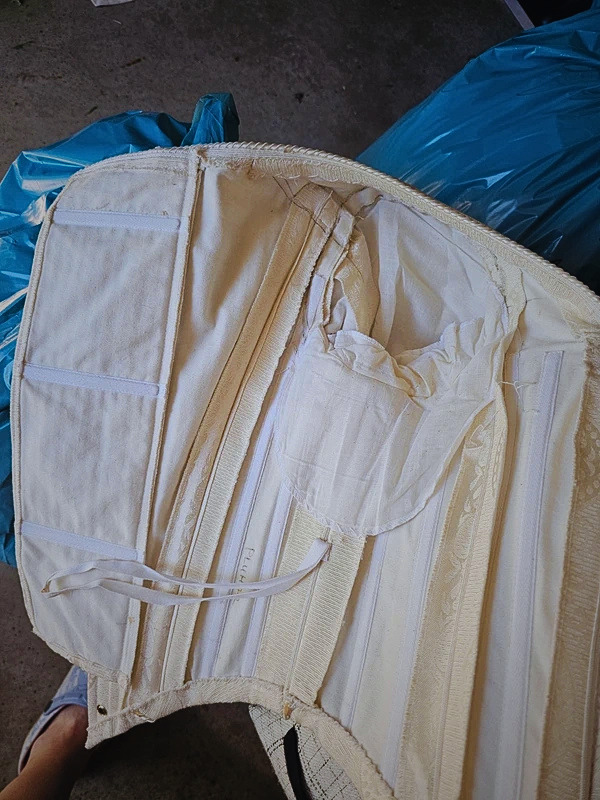
Having received the bodice in beautiful shape, trying on to ensure fit as well as freedom of mobility, there are a few interesting details I find worth mentioning:
This beautiful bodice, that I have all the intentions of using for future programmes was most probably made using a modern pattern. The first thing that supports this theory is of course the back closure, which could be seen in the listing photos. The second evidence I have is how the bodice’ sleeves were attached to the bodice’ arm hole. One important sewing technique I have learned about in “The American duchess guide to 18th century dress making” was the technique of attaching the sleeves while the arms is at an elevated position, which meant that the sleeve, while attached, would allow for elevated arm movements. Another interesting element is on many 18th century bodices the arm hole seems to have been placed much higher on the bodice- this smart trick ensures that while raising the arm the rest of the bodice will not raise with it. So the specific modern pattern and sewing technique in which the sleeves of my German theater bodice were attached do not currently allow for elevation of the arm above shoulder height.
Interestingly this modern sleeves attaching technique correlates with a false assumption that historical garments did not allow for full arm mobility. These two historical techniques alone bust this myth right open, or at least invite a healthy amount of skepticism while encountering this “people couldn’t move their arms that high as we do” line of thinking.
At the moment I plan to use and enjoy this bodice with movements that will fit its modern limitations. No shade intended to its makers- they have done a beautiful job and to a level I cannot replicate myself. Perhaps in the future I will try to mend the mobility limitation with a modern technique, that I have learned and used in the past, of inserting a clam shape gusset (extra fabric which added usually under the arm). The advantage of this technique and the clam shape addendum, is that it gives more range of mobility, while at the same time creating a quite discrete seam while the arms are at rest. The only challenge would be to find a matching fabric to manufacture the clam shapes out of. One option would be to create a new rectangular panel for the bodice’ back closure, and to use the existing one to cut the clam gussets. But this project is for a later date, if for any date.
As I already mentioned, the seller of this bodice didn’t not have more information to shine a light as to the exact provenance of this bodice. However while opening and inspecting the bodice on the day I received it, I immediately noticed that, true to German theater custom, the name of its wearer was written on the inside: Pluhar. Pluhar! The exclamation is here to give away the level of my excitement. There is a very prominent actor and writer from Austria called Erika Pluhar. She is known for her huge repertoire range from classic to modern. It would be a pretty sweet if she was the actor this bodice was built for. Of course there are probably so many more Pluhar actors out there that I am not aware of. But so far I am pleased with the information this bodice has given me. I am very excited to wear it for the first time for a concert-lecture in Groningen at the beginning of the coming July. This hybrid event (which I lovingly call- p(l)a(y)per. A play on a play and a paper presentation) would dive deep into the production of Psyche by Lully which was to be presented in The Hague for the well awaited peace declaration, which (spoiler alert) didn’t formulate for the time of the production.
Historical Acting Historical costuming Michal Bitan